
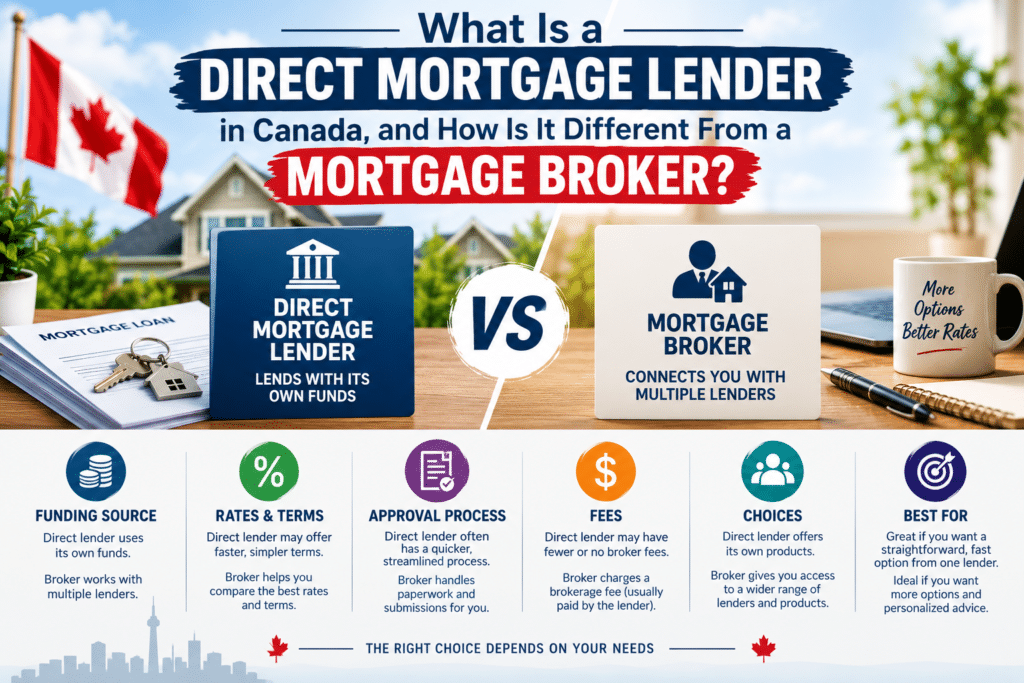
What Is a Direct Mortgage Lender in Canada, and How Is It Different From a Mortgage Broker?
If you’re shopping for a mortgage or refinancing your home in Canada, you’ve likely come across two very different paths: working with a mortgage broker or going straight to a direct lender. The choice can affect your interest rate, the mortgage options you see, and even the advice you receive.
Here’s a clear breakdown of what each one is, how they differ, and which route might make sense for your situation.
What Is a Direct Mortgage Lender?
A direct mortgage lender is a financial institution that provides mortgage funds directly to borrowers using its own capital. Banks, credit unions, monoline lenders (lenders that focus exclusively on mortgages), and private finance companies are all direct lenders.
Direct lenders include:
- Major Canadian banks (RBC, TD, Scotiabank, BMO, CIBC)
- Credit unions
- Monoline lenders (like First National Financial)
- Private lending companies
When you go to a direct lender, you’re dealing with the institution that actually makes the lending decision. A bank advisor or mortgage specialist at the institution evaluates your application, and the lender decides whether to approve or decline you based on their own underwriting criteria.
The key limitation: direct lenders can only offer their own mortgage products, rates, and approval rules. If you walk into a TD branch, you’ll only see TD’s mortgages. You won’t see what RBC, BMO, or a credit union might offer.
What Is a Mortgage Broker?
A mortgage broker is a licensed professional who acts as a bridge between borrowers and multiple lenders. Instead of going to one bank, a broker shops the market on your behalf, comparing rates and products from dozens of lenders, including major banks, credit unions, monoline lenders, and alternative or private lenders.
How brokers get paid: In most cases, brokers are paid by the lender once the mortgage is funded, not by you. This means you typically get expert help at no direct cost to you.
The broker’s advantage: A single application submitted through a broker reaches multiple lending options through one point of contact. This broad access can be especially valuable if your financial situation doesn’t fit a standard bank template, for example, if you’re self-employed, new to Canada, or have bruised credit.
Direct Lender vs. Mortgage Broker: Key Differences
| Factor | Direct Lender | Mortgage Broker |
| Lender access | One institution only | Multiple lenders (banks, credit unions, private lenders) |
| Product variety | Limited to in-house products | Wide range of options from different lenders |
| Cost to borrower | May charge origination fees (0–1%) | Usually zero; lender pays commission |
| Approval flexibility | Stricter criteria; harder with bad credit | Can access lenders for diverse financial situations |
| Processing time | 21–30 days on average | 35–50 days on average |
| Communication | Direct with the lender | Through the broker as intermediary |
Pros and Cons of Each Approach
Direct Lender
Pros:
- Simplicity and familiarity. If you already bank with a major institution, going direct can feel straightforward. You can often bundle banking products under one roof.
- Direct communication. You speak directly with the people making the lending decision.
- Potential loyalty discounts. Some banks offer preferred rates to existing customers.
Cons:
- Limited options. You’re restricted to one lender’s products and rates.
- Stricter approval criteria. Banks often have rigid guidelines that can make approval difficult if your credit isn’t perfect.
Mortgage Broker
Pros:
- Access to more lenders and products. Brokers can compare rates across dozens of institutions.
- Better for unique situations. Self-employed, new to Canada, or have bruised credit? A broker can explore alternative lenders that banks won’t offer directly.
- Expertise and personalized service. A good broker guides you through documentation and strategizes to help you qualify.
- Usually no cost to you. The lender pays the broker.
Cons:
- Quality varies between brokers. An inexperienced broker may not add much value.
- Less direct communication. You may not interact directly with the lender until final approval.
- Possible fees in specialized situations. Some non-prime or private deals may involve broker fees—always ask upfront.
The Application Process: What to Expect
Working with a Direct Lender
- You contact the lender (online, by phone, or in-branch)
- A bank advisor or mortgage specialist collects your financial information
- The lender evaluates your application against their own criteria
- You receive a decision—approved or declined
- If approved, the lender funds your mortgage directly
Working with a Mortgage Broker
- You meet with a broker who reviews your financial situation
- The broker shops your application to multiple lenders
- Lenders review your file and respond with offers
- The broker presents you with the best options
- You choose an offer and the lender funds your mortgage
The key difference: with a broker, one application reaches many lenders; with a direct lender, one application reaches just one institution.
Which One Is Right for You?
The best choice depends on your priorities. A mortgage broker is usually the better starting point if you want to compare multiple lenders and improve your chances of finding a more competitive rate or mortgage structure. Going directly to a lender may be simpler if you value brand familiarity and already have a strong banking relationship.
Borrowers who want broader choice, more rate comparison, or help with a more complex financing situation often benefit from using a broker. Borrowers who prefer a single institution and a straightforward, branch-based experience may prefer to deal directly with a lender.
Some borrowers choose both. Many Canadians start by getting a quote from their bank (the direct lender route) and also speaking with a broker to see if better options exist. Since broker services are usually free, there’s little downside to exploring both paths.
How Private Direct Lenders Fit In
Beyond the major banks, private direct lenders like BHM Financial offer alternative financing options for borrowers who don’t qualify through traditional channels. Private lenders typically base lending decisions on asset value (like home equity or vehicle equity) rather than credit scores alone.
For Canadian homeowners who have been turned down by banks, perhaps due to bad credit, past bankruptcy, or non-traditional income, private direct lenders can be a viable alternative. These lenders are regulated private finance firms that provide secured loans backed by real estate or other assets.
Whether you choose a broker, a bank, or a private lender, the most important step is understanding your options and choosing the path that fits your financial situation.
Frequently Asked Questions
Is a mortgage broker free in Canada?
In most cases, yes. Brokers are paid by the lender once the mortgage is funded, so you typically don’t pay anything out of pocket.
Can a mortgage broker get me a better rate than a bank?
Often yes. Because brokers have access to wholesale rates and compete across multiple lenders, they can frequently secure rates that are 0.10%–0.40% lower than what banks offer directly.
Do banks work with mortgage brokers?
Yes. Many major Canadian banks, including TD, Scotiabank, and BMO, work with brokers.
What’s the difference between a bank and a direct lender?
A bank is one type of direct lender. Direct lenders also include credit unions, monoline lenders, and private finance companies—any institution that funds mortgages using its own capital.
Can I get a mortgage if I have bad credit?
Yes, but it may be easier through a broker or a private direct lender. Brokers have access to lenders who cater to borrowers with diverse financial backgrounds. Private lenders may base decisions on asset value rather than credit scores alone.
How long does it take to get approved for a mortgage?
Direct lenders average 21–30 days to close, while broker-arranged mortgages typically take 35–50 days. However, these timelines can vary significantly based on your situation.
Should I get pre-approved before shopping for a home?
Yes. A pre-approval gives you a clear range of how much you can afford and strengthens your offer when you find a home.
What is a monoline lender?
A monoline lender is a direct lender that focuses exclusively on mortgages and doesn’t offer other banking products like chequing accounts or credit cards.
Can I use a mortgage broker if I’m self-employed?
Absolutely. Brokers often have access to lenders who specialize in self-employed mortgages, which banks may not offer directly.
Do I need to be a Canadian citizen to get a mortgage in Canada?
Not necessarily. Permanent residents and some non-residents may qualify, though requirements vary by lender. Brokers can help identify lenders with flexible policies for newcomers.
What happens if my mortgage application is rejected by a bank?
You can try another lender directly or work with a broker who can access multiple lenders, including alternative and private lenders that may have more flexible criteria.
Can I negotiate mortgage rates with a direct lender?
Yes, especially if you have a strong credit profile or are an existing customer. Brokers can also negotiate on your behalf across multiple lenders.
What’s the difference between a first mortgage and a second mortgage?
A first mortgage is the primary loan against a property; the lender is in first position. A second mortgage is an additional loan against the same property, with the lender in second position behind the first mortgage holder.
How much can I borrow with a private direct lender?
It depends on the value of your asset (like home equity) and your ability to repay. Private lenders typically base loan amounts on the equity you have in your property rather than your credit score.
Is it better to use a broker or go direct?
There’s no single right answer. A broker offers more options and may find better rates; a direct lender offers simplicity and direct communication. Many borrowers explore both before deciding.
Your Next Step
Understanding the difference between a direct mortgage lender and a mortgage broker is the first step in making an informed financing decision. If you’re a Canadian homeowner exploring your options, whether through a bank, a broker, or a private lender, knowing how each path works will help you choose the right one for your situation.
For homeowners who have been turned down by traditional banks, private direct lenders may offer an alternative path based on your home equity rather than your credit history alone. Learn more about secured mortgage options in Canada.