
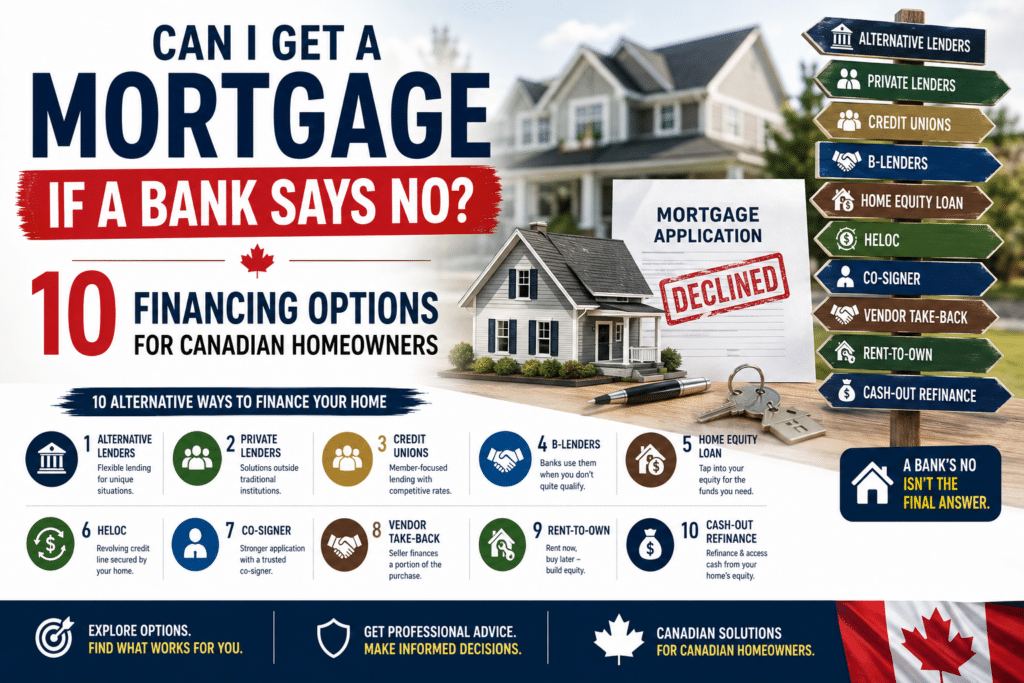
Can I Get a Mortgage If a Bank Says No? 10 Financing Options for Canadian Homeowners
Getting a mortgage decline from a bank can feel like a dead end. You’ve found the home, saved the down payment, and now the lender says no. It’s frustrating. But here’s the truth: a bank decline is not the end of your mortgage journey. Thousands of Canadians face this situation every year, and many still become homeowners.
This guide explains why banks say no and covers 10 realistic financing options for Canadian homeowners who have been turned down.
Why Do Banks Decline Mortgages?
Understanding why banks say no is the first step toward finding a solution. Here are the most common reasons:
Poor Credit Score
Banks typically require a score of 620 or higher. Late payments, collections, or bankruptcy can bring your score below this threshold. A mortgage declined due to credit score is one of the most common rejections.
Low Income or High Debt
Lenders evaluate your debt-to-income ratio. If your housing costs exceed 39% of your income or your total debt exceeds 44%, you may be declined. A mortgage declined due to income often happens with self-employed borrowers who show low net income on tax returns.
Insufficient Down Payment
First-time buyers need at least 5% down, but with bad credit, banks often demand 20% or more. A mortgage declined self-employed Canada is common because income verification is more complex.
Mortgage Stress Test Failure
Since 2016, all federally regulated lenders must apply the stress test. Even if you can afford the payments at today’s rate, failing the stress test means you don’t qualify.
Property Issues
Some properties don’t meet lender standards: condos with pending lawsuits, rural properties, or homes with unpermitted renovations.
10 Financing Options After a Bank Denial
Here are ten realistic alternatives when a bank says no.
1. Work with a Mortgage Broker
Who it suits: Anyone who wants access to multiple lenders without shopping around themselves.
A mortgage broker Canada is a licensed professional who connects borrowers with lenders. They have access to dozens of lenders, including banks, credit unions, and alternative lenders, and can shop for rates and terms on your behalf.
Main benefit: Brokers often have access to wholesale rates you can’t get directly. Their services are usually free to you (paid by the lender).
Drawback: Quality varies between brokers. An inexperienced broker may not add much value. Some brokers may charge fees for difficult-to-place mortgages.
2. B-Lenders / Alternative Mortgage Lenders
Who it suits: Borrowers with credit scores in the 550–650 range who don’t qualify for prime rates.
B-lenders are institutional lenders that don’t have a bank charter but follow similar regulations. They approve borrowers who don’t meet the stress test but still have solid income and a decent down payment.
Main benefit: More flexible than banks. They look at your full financial picture, not just numbers.
Drawback: Rates are higher, typically 7–10% compared to 4–7% at major banks. Expect fees of 0.5–2% of the loan amount.
3. Private Mortgage Lenders
Who it suits: Borrowers with poor credit, self-employed individuals with low taxable income, or those needing fast funding.
A private mortgage Canada is funded by individuals, investor groups, or Mortgage Investment Corporations (MICs). Approval is based primarily on your property equity, not your credit score or income. Private lenders like offer these types of mortgages for homeowners who don’t qualify through traditional banks.
Main benefit: Fast approval (24–72 hours) and no stress test. Accessible to borrowers with bankruptcy, consumer proposal, or no Canadian credit history.
Drawback: Higher rates (8–15%) and lender fees (1–3%). Short terms (3–24 months) with interest-only payments. You must have a clear exit strategy.
4. Second Mortgage
Who it suits: Homeowners with existing equity who want to borrow more.
A second mortgage Canada is an additional loan behind your first mortgage. You get access to your home equity without refinancing the primary loan.
Main benefit: Good for debt consolidation, renovations, or major expenses.
Drawback: Higher rates than first mortgages because the lender is in second position. Expect 8–15% interest. Default puts your home at risk.
5. Home Equity Loan or HELOC
Who it suits: Homeowners who need flexible access to their equity.
A home equity loan Canada lets you borrow against your paid-down property. A Home Equity Line of Credit (HELOC) works like a credit card secured by your home equity.
Main benefit: Lower rates than private or B-lenders because your home secures the debt.
Drawback: HELOC rates are variable. You can access a HELOC with bad credit only through alternative lenders, and rates will be higher. Missed payments can trigger default.
6. Co-signer Mortgage
Who it suits: Borrowers with low income, poor credit, or limited Canadian credit history.
A mortgage co-signer Canada is a family member or trusted person with good credit who signs the mortgage with you. Their income and credit strengthen your application.
Main benefit: Opens doors to prime lenders with good rates. You can buy a home you couldn’t afford alone.
Drawback: The co-signer is responsible if you default. This can strain relationships and affect their ability to borrow for themselves.
7. Larger Down Payment
Who it suits: Borrowers who can borrow from family or access savings.
Putting down 20% or more reduces the lender’s risk. With a larger down payment mortgage, the LTV ratio drops, making approval easier even with bad credit.
Main benefit: Lower LTV often means better rates. You avoid CMHC insurance fees.
Drawback: Takes time to save. You need significant cash resources.
8. Mortgage Refinance with Bad Credit
Who it suits: Homeowners looking to consolidate debt or access equity.
Mortgage refinance Canada means replacing your existing mortgage with a new one, often to access equity or lower payments.
Main benefit: Good for debt consolidation or tapping into equity.
Drawback: With bad credit, you may only qualify with B-lenders or private lenders at higher rates. The new loan might cost more than your current one.
9. Credit Rebuilding and Reapplying
Who it suits: Borrowers who can wait 6–12 months before buying.
Focus on rebuilding credit after a mortgage decline by paying bills on time, reducing debt, and disputing credit report errors.
Main benefit: You can qualify for better rates when you reapply. This is the most affordable long-term path.
Drawback: Takes time and patience. You delay your homeownership plans.
10. Mortgage Investment Corporation (MIC)
Who it suits: Borrowers who don’t qualify with banks or B-lenders.
A mortgage investment corporation Canada pools investor money to fund mortgages. These lenders provide private mortgage fast approval with terms often around 1–2 years.
Main benefit: Reliable source of private mortgage capital. Structured more like institutional lending than individual investors.
Drawback: Higher rates and fees, same as private lenders. Short terms mean you’ll need to refinance or sell quickly.
Summary Table: 10 Financing Options
| Option | Best For | Main Benefit | Main Drawback |
| Mortgage Broker | Anyone | Access to multiple lenders | Quality varies |
| B-Lenders | Credit scores 550–650 | Flexible criteria | Higher rates (7–10%) |
| Private Lender | Poor credit, self-employed | Fast approval, no stress test | High rates (8–15%), short terms |
| Second Mortgage | Homeowners with equity | Access equity | Higher rates, foreclosure risk |
| Home Equity Loan | Homeowners with equity | Lower rates than private | Requires equity |
| Co-signer Mortgage | Low income, poor credit | Access to prime rates | Co-signer has liability |
| Larger Down Payment | Those with savings | Lower LTV, better rates | Requires large cash |
| Refinance | Debt consolidation | Access equity | May cost more with bad credit |
| Credit Rebuilding | Those who can wait | Better rates eventually | Takes 6–12 months |
| MIC | Complex borrowers | Reliable capital | Higher rates, short terms |
The Bottom Line
A mortgage decline from a bank isn’t the final word. Whether you’re exploring bad credit mortgage Canada options, considering a private mortgage, or working with a broker to find alternative mortgage lenders, there’s almost always a path forward.
Take these steps:
- Get your credit report and understand why you were declined
- Work with a licensed mortgage professional who understands your situation
- Be realistic about costs and risks
- Have a clear plan to rebuild or refinance
At BHM Financial, we understand that every borrower’s situation is unique. We offer equity-based mortgage solutions for Canadians who don’t qualify through traditional banks, helping homeowners access the financing they need.
Frequently Asked Questions
Can I get a mortgage if a bank says no?
Yes. Banks decline applications for many reasons, but there are dozens of alternative lenders and financing options available.
Why do banks decline mortgages?
Common reasons include low credit scores, insufficient income, high debt-to-income ratios, failing the stress test, or property issues.
What to do if mortgage is declined?
Ask the bank why, review your credit report, and explore alternatives like mortgage brokers or B-lenders.
How long after mortgage decline can I reapply?
You can reapply immediately with a different lender. If you’re working to repair credit, wait 6–12 months for improvement.
Can I get a mortgage with bad credit in Canada?
Yes. Private lenders, B-lenders, and Mortgage Investment Corporations approve borrowers with lower credit scores.
What are alternative mortgage lenders?
Non-bank institutions that provide mortgages with more flexible approval criteria. B-lenders, private lenders, and MICs are examples.
What is a B-lender in Canada?
A non-bank institutional lender that offers mortgages to borrowers who don’t qualify for prime rates. They have higher rates but more flexible approval criteria.
Can I get a mortgage after bankruptcy?
Yes. Usually requires 2 years post-discharge and a solid down payment, often with a private or B-lender.
Can I get a mortgage after a consumer proposal?
Yes. Many lenders will consider you once the proposal is completed and you’ve re-established some credit history.
Can self-employed Canadians get a mortgage?
Yes. Self-employed borrowers often use B-lenders or private lenders that accept alternative income verification like bank statements.
Can newcomers get a mortgage in Canada?
Yes. Private lenders and some B-lenders approve newcomers based on property equity rather than Canadian credit history.
What is a private mortgage lender?
A non-institutional lender that funds mortgages using private capital, approving borrowers based on property equity.
What credit score do I need for a mortgage in Canada?
Prime lenders typically require 620+. B-lenders may approve scores as low as 550. Private lenders have no minimum; approval is based on asset value.
Are private mortgages safe?
They carry risks, higher costs, short terms, and interest-only payments. Always have a clear exit strategy.
What is a Mortgage Investment Corporation (MIC)?
A corporation that pools investor money to fund mortgages. MICs are regulated and provide a reliable source of private mortgage capital.
How does a second mortgage work?
It’s an additional loan against your property, behind your first mortgage. The second mortgage lender takes second position, meaning you default, the first mortgage lender gets paid first.
Can I get a home equity loan with bad credit?
Yes, but mostly through B-lenders or private lenders at higher rates. Banks typically require good credit for home equity loans.
Is mortgage refinancing with bad credit possible?
Yes, but likely through B-lenders or private lenders at higher rates and with lender fees.
How can I improve my chances of mortgage approval?
Improve your credit score, reduce debt, save for a larger down payment, and work with a licensed mortgage professional.
What is the easiest mortgage to qualify for with bad credit?
Private mortgages typically have the most flexible approval criteria because the lender focuses on property equity rather than credit score.
Your Next Step
A bank decline isn’t the end; it’s the beginning of exploring better options. Take time to understand why you were declined, explore the alternatives that fit your situation, and work with professionals who can guide you.
Explore your mortgage options in Canada with BHM Financial.